

Pop quiz: which hemisphere of our brain is the nuts-and-bolts, “just the facts, ma’am” side, and which is the artsy-fartsy hippie side?
Well, we used to think it was that easy…
Traditionally, the left side was thought to be more associated with logic and reasoning, and the left with emotions, impulses, and being a creative genius. To some degree lateralization of the brain is somewhat true, but not really…
Turns out there’s more complementary and associated functions that require both sides being involved to varying degrees. There’s even an anatomical structure that connects the two sides of our brain: the corpus callosum . (More definition.)
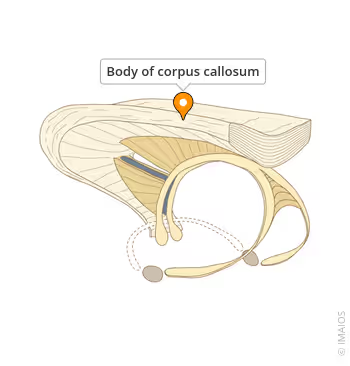
I can’t explain it, but when I see this structure it reminds me of Rainbow Road… I know, I know, my hyper-nerd ADHD brain is in full gear; but seriously, f#ck that level.

Why do we need to have communication between the two hemispheres? Because a lot of problems happen when two sides don’t understand each other. (Well, no sh!t Sherlock…)

The corpus callosum carries a lot of nerve bundles having to do with sensory and motor information, coordinating physical movement, language processing, memory consolidation, to only name a very select few. So if that bridge is shut down or altered, for whatever reason, well, those aspects start to not work very well, and can result in issues like ataxia (speech and/or movement), seizures, intellectual and learning disabilties, or cerebral palsy, just to name a few. So yeah, very serious problems.
Essentially, this little bridge helps the whole thing run smoothly and properly. We NEED both sides of our brain to not only communicate with each other, but to actually get along, meaning, operate together, in concert with the other.

We use more of our brains than we think, and in an infinite number of ways we never thought before.
Connecting the seemingly differing aspects of our brains is essential to optimal learning and development.
It is widely known in childhood development physiology that doing cross-body movement exercises (plus other activities) boosts nerve impulses across this bridge, and is a reliable marker of potential developmental delays or structural brain abnormalities.
So, to all my clients over the years whom I’ve recommended to take up Tai Chi for brain and neurological health… Told ya 😉 (No really, I taught regular Tai Chi classes when I worked in Long Term Care and I saw massive benefits in my Residents’ mobility and cognition. In fact, if I ever missed a class, not only were they pissed off, they were agile enough to chase me down and berate me for depriving them of their practice time. So, obviously it worked and they loved it.)

Anecdotal evidence aside, there really seems to be something here that, to anyone with even one eye open to the world, seems right… There’s more to life than individualism — things, people, everything, is connected in some way or another. Dualism is the error: “DesCartes’ Error” by Antonio Damasio is a great book telling a variety of case studies ranging from how our emotions and feelings play a crucial role in thinking and reasoning, to why trauma to the frontal lobe can make you a capital asshole.
In massage therapy, we pride ourselves on our “evidence-based” practice models, as we should. However, I have a personal plea to my fellow ultra-sciencey minded colleagues to not forget the art of our practice…
In developing and solidifying our place in the greater scope of Western medicine through empirical research and study, we cannot let ourselves lose sight of the feel that is so integral to our connection with our patients, and our connection to the work itself.
One of my secret passions (shh, don’t tell anyone) is the merging of hemispheres, of art and science, of passion and discipline.
One will always make the other better.

Going to be lots of twists and turns down this rabbit hole — coming eventually — part 2: Massage Therapy’s New Mistress: Research and Empirical Evidence.